
Abstract
Aim
To map the scientific landscape of artificial intelligence (AI) applications in oral and maxillofacial surgery (OMFS) over the last 25 years using bibliometric and science-mapping methods.
Materials and Methods
Publications related to AI and OMFS were retrieved from the Web of Science Core Collection. A comprehensive search was performed, and the complete set of 2153 records was exported. After restricting the timespan to 2000-2025 and limiting the document type to articles and reviews, 1955 documents were included. Bibliometric indicators were calculated, and science maps were generated in VOSviewer for co-authorship, co-occurrence, citation, and co-citation analyses.
Results
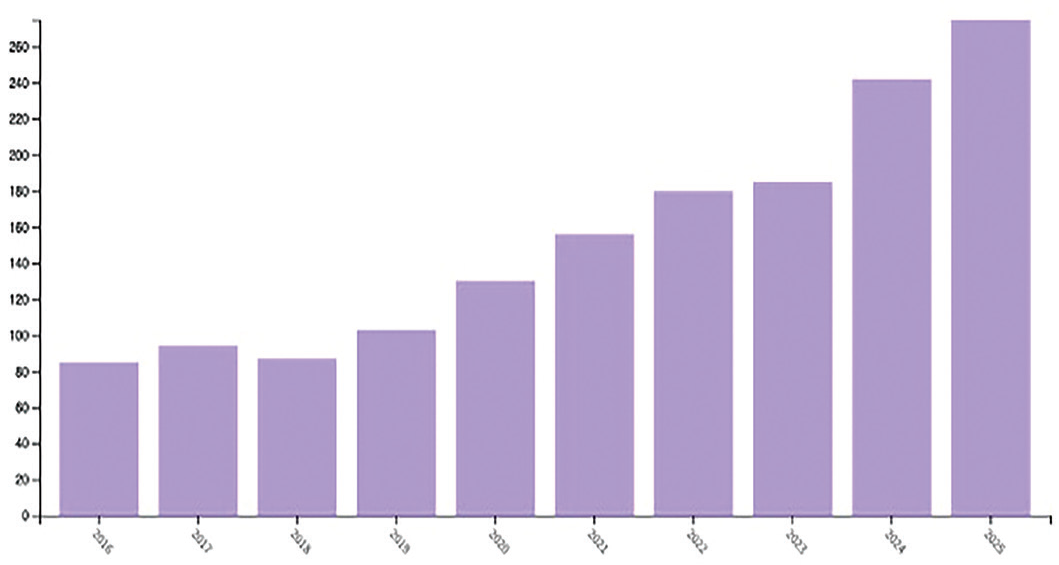
The annual number of publications increased markedly after 2015, with a steep rise from 2020 onwards and a peak of 275 publications in 2025. Overall, 1678 articles (87.8%) and 232 reviews (12.2%) were identified, totaling 38648 citations (mean 20.2 citations per document). The most productive journals were the Journal of Craniofacial Surgery, the Journal of Cranio-Maxillofacial Surgery, and the International Journal of Oral and Maxillofacial Surgery. Keyword co-occurrence analysis revealed major thematic clusters related to orthognathic surgery, mandibular reconstruction, computer-assisted surgery, virtual surgical planning, 3D printing, and deep learning.
Conclusion
AI research at the interface of OMFS has expanded rapidly between 2000 and 2025, particularly in AI-assisted surgical planning, anatomical segmentation for operative workflows, and computer-assisted surgery. These findings highlight how AI-supported technologies are increasingly being investigated for integration into contemporary clinical workflows in OMFS and provide guidance for clinicians regarding future implementation and validation priorities. In addition to clinical insights, these findings provide an overview of the AI research landscape in OMFS, offering guidance for future algorithm development, validation strategies, and interdisciplinary research directions.
Keywords: Artificial intelligence, bibliometric analysis, oral and maxillofacial surgery, science mapping, surgical planning
Introduction
Over the past 10 years, advances in machine learning and deep learning, along with the increased availability of digital surgical data, have driven growing interest in artificial intelligence (AI) in oral and maxillofacial surgery (OMFS). The growing importance of AI in OMFS has been highlighted by recent narrative and systematic studies, particularly in surgical planning, anatomical analysis, and clinical decision-making. (-).
Among the various clinical applications, orthognathic surgery has emerged as a key area for integrating digital and AI-assisted technologies. Virtual surgical planning, simulation, and patient-specific surgical guides have been widely investigated as tools to improve surgical accuracy and predictability (-). In parallel, deep learning–based methods have been introduced to automate tasks such as mandibular segmentation and identification of critical anatomical structures, which are essential components of contemporary OMFS workflows (-).
These methods enhance surgical planning and operative decision-making rather than relying solely on stand-alone radiological evaluations, even though they often rely on imaging-derived data. This differentiation highlights the essentially surgical focus of AI applications in OMFS and distinguishes them from studies in diagnostic imaging.
Several authors have discussed the broader implications of AI in dentistry and healthcare, in addition to procedure-specific studies. These contributions offer crucial conceptual and methodological frameworks for comprehending the creation, verification, and constraints of AI-based systems in clinical practice (-). More recently, OMFS-specific systematic reviews have synthesised evidence on AI applications across surgical subspecialties, highlighting the field’s existing methodological shortcomings and potential advantages ().
Despite the growing volume of literature, existing reviews primarily offer qualitative or application-focused perspectives and provide limited insight into publication trends, collaborative research structures, and the thematic evolution of AI-related OMFS research over time. Bibliometric and science mapping approaches are well-suited to address these gaps by quantitatively assessing research output, identifying influential contributors, and visualising emerging research themes.
Beyond its clinical relevance, systematically mapping the structure, evolution, and thematic focus of AI research in OMFS is essential to guide future algorithm development, foster interdisciplinary collaboration, and identify methodological gaps within the AI research landscape (-).
Therefore, the present study aimed to conduct a comprehensive bibliometric and science-mapping analysis of AI applications in OMFS published between 2000 and 2025.
Materials and Methods
Study Design
This study followed a bibliometric and science-mapping design and was conducted in accordance with reporting recommendations for bibliometric analyses. Because only published literature was analysed and no individual patient data were used, ethical approval was not required.
Data Source and Search Strategy
The Web of Science (WoS) Core Collection was chosen as the data source for its strict indexing guidelines and suitability for citation-based analysis. A thorough search was conducted to find articles on AI applications in OMFS. OMFS and dental imaging terms were merged with free-text terms pertaining to deep learning and AI in the search approach. Excluded were studies with a primary focus on dentomaxillofacial radiography that had no direct bearing on surgical planning, intervention, or results in OMFS. A representative Boolean query was:
Topic search= [(“AI “ or “deep learning” or “machine learning” or “neural network*” or “radiomics”)] and (“oral and maxillofacial” or “maxillofacial surgery” or “orthognathic” or “mandibular reconstruction” or “dentofacial deformit*” or “dental implant*” or “cone-beam computed tomography” or “ CBCT” or “panoramic radiograph*”).
The initial search of the WoS Core Collection retrieved 2153 records with no restrictions. All records were exported in plain-text format with complete records and cited references.
Study Selection and Data Cleaning
In a first screening step, the timespan was restricted to publications from 1 January 2000 to 31 December 2025. Publication counts for 2025 reflect partial-year data, as records were retrieved on 9, 2025, before the calendar year ended. Only items indexed as “article” or “review” were retained; conference proceedings, editorial materials, letters, and corrections were excluded by using WoS document-type filters. After this restriction and the exclusion of records, 1955 documents remained and were included in the quantitative analyses.
To prepare the data for science-mapping analyses, author names, institutional affiliations, and keywords were cleaned and normalised. Variants of the same term (e.g., “computer-aided surgery” and “computer-assisted surgery”) were merged, spelling errors were corrected, and singular and plural forms were unified where appropriate. Author keywords (DE field) and Keywords Plus (ID field) were combined to generate a unified keyword list. Data cleaning was performed using spreadsheet tools and custom scripts before importing the dataset into VOSviewer. Conceptually overlapping terms such as computer-aided surgery, computer-assisted surgery, and computer-aided design (CAD)/computer-aided manufacturing (CAM) were merged under unified keyword categories prior to frequency analysis. Imaging-related terms were included to ensure comprehensive retrieval of AI studies supporting surgical planning and workflows, while studies focusing solely on diagnostic radiology without surgical relevance were excluded during data cleaning. Following data cleaning procedures and the application of predefined inclusion criteria, 1.955 publications were retained for bibliometric and science mapping analyses.
Bibliometric Indicators
Descriptive bibliometric indicators were calculated for the overall dataset, including the annual number of publications, document types, total and average citations per document, and productivity rankings for countries, institutions, authors, and journals. Citations were counted as of the WoS export date.
Statistical Analysis
Science-Mapping Analysis
Science maps were generated using VOSviewer (version 1.6.20; Centre for Science and Technology Studies, Leiden University, The Netherlands). Co-authorship analyses were performed at the author, institution, and country levels using complete counting. Co-occurrence analyses were conducted for author keywords; only keywords with a minimum of five occurrences in the dataset were included in the maps. Citation and co-citation analyses were carried out for journals and individual documents. Normalisation of similarities was based on the association strength method, and clusters were identified using VOSviewer’s default clustering algorithm. Overlay visualisation was used to explore temporal trends, with node colour representing the average publication year of items.
Results
Descriptive Overview of the Dataset
A total of 1955 WoS-indexed documents on AI applications in OMFS were published between 2000 and 2025. Of these, 1720 (87.9%) were original research articles and 235 (12.1%) were review papers. The cumulative number of publications increased modestly in the early 2000s and then accelerated from approximately 2015 onwards, with a marked rise after 2020, peaking at 275 in 2025. () The total number of citations received by the included documents was 38648, corresponding to an average of 20.2 citations per document. Most publications were written in English (97.4%), with only a limited number published in other languages.
The country collaboration network is visualised in , revealing dense collaborative clusters among high-output countries and indicating that international co-authorship plays a substantial role in advancing research on AI in OMFS.
Most Highly Cited Publications
lists the 20 most highly cited documents in the dataset. These publications predominantly address 3D printing, computer-assisted and image-guided surgery, virtual surgical planning, and mandibular reconstruction, which together form the historical core of digital OMFS.
Table 1. The 20 most highly cited publications on artificial intelligence applications in oral and maxillofacial surgery (2000-2025)
Rank | First author | Year | Title | Journal | Document type | Citations |
|---|---|---|---|---|---|---|
1 | Tack, Philip | 2016 | 3D-printing techniques in a medical setting: a systematic literature review | Biomedical Engineering Online | Review | 738 |
2 | Warnke, PH | 2004 | Growth and transplantation of a custom vascularised bone graft in a man | Lancet | Article | 537 |
3 | Martelli, Nicolas | 2016 | Advantages and disadvantages of 3-dimensional printing in surgery: a systematic review | Surgery | Review | 460 |
4 | Hsu, Sam Sheng-Pin | 2013 | Accuracy of a computer-aided surgical simulation protocol for orthognathic surgery: a prospective multicenter study | Journal of Oral and Maxillofacial Surgery | Article | 321 |
5 | Cohen, Adir | 2009 | Mandibular reconstruction using stereolithographic 3-dimensional printing modelling technology | Oral Surgery Oral Medicine Oral Pathology Oral Radiology and Endodontology | Article | 281 |
6 | Tian, Yueyi | 2021 | A review of 3D printing in dentistry: technologies, affecting factors, and applications | Scanning | Review | 275 |
7 | Hirsch, David L. | 2009 | Use of computer-aided design and computer-aided manufacturing to produce orthognathically ideal surgical outcomes: a paradigm shift in head and neck reconstruction | Journal of Oral and Maxillofacial Surgery | Article | 267 |
8 | Chae, Michael P. | 2015 | Emerging applications of bedside 3D printing in plastic surgery | Frontiers in Surgery | Review | 257 |
9 | Malik, Hammad H. | 2015 | Three-dimensional printing in surgery: a review of current surgical applications | Journal of Surgical Research | Review | 250 |
10 | Plooij, Joanneke M. | 2011 | Digital three-dimensional image fusion processes for planning and evaluating orthodontics and orthognathic surgery. A systematic review | International Journal of Oral and Maxillofacial Surgery | Review | 221 |
11 | Hoang, Don | 2016 | Surgical applications of three-dimensional printing: a review of the current literature & how to get started | Annals of Translational Medicine | Review | 217 |
12 | Hanasono, Matthew M. | 2013 | Computer-assisted design and rapid prototype modelling in microvascular mandible reconstruction | Laryngoscope | Article | 215 |
13 | Widmann, G | 2006 | Accuracy in computer-aided implant surgery - a review | International Journal of Oral & Maxillofacial Implants | Review | 206 |
14 | Block, Michael S. | 2017 | Implant placement accuracy using dynamic navigation | International Journal of Oral & Maxillofacial Implants | Article | 206 |
15 | Hassfeld, S | 2001 | Computer-assisted oral and maxillofacial surgery - a review and an assessment of technology | International Journal of Oral and Maxillofacial Surgery | Review | 203 |
16 | Ewers, R | 2005 | Basic research and 12 years of clinical experience in computer-assisted navigation technology: a review | International Journal of Oral and Maxillofacial Surgery | Review | 201 |
17 | Eggers, G. | 2006 | Image-to-patient registration techniques in head surgery | International Journal of Oral and Maxillofacial Surgery | Review | 189 |
18 | Stokbro, K. | 2014 | Virtual planning in orthognathic surgery | International Journal of Oral and Maxillofacial Surgery | Article | 187 |
19 | Plooij, J. M. | 2009 | Evaluation of reproducibility and reliability of 3D soft tissue analysis using 3D stereophotogrammetry | International Journal of Oral and Maxillofacial Surgery | Article | 183 |
20 | Antony, Anuja K. | 2011 | Use of virtual surgery and stereolithography-guided osteotomy for mandibular reconstruction with the free fibula | Plastic and Reconstructive Surgery | Article; Proceedings Paper | 182 |
Most Productive Journals
The most productive journals in this field were Journal of Craniofacial Surgery (n=145), Journal of Cranio-Maxillofacial Surgery (n=138), International Journal of OMFS (n=123), and Journal of Oral and Maxillofacial Surgery (n=108). Several multidisciplinary and engineering journals, such as Applied Sciences and Scientific Reports, also contributed substantially to the literature, reflecting the interdisciplinary nature of AI research in OMFS. The 10 most productive journals publishing AI-related OMFS research are summarised in . The dominance of core OMFS journals highlights that AI-related research is being increasingly disseminated within speciality-specific surgical outlets rather than general radiology or engineering journals.
Table 2. The most productive journals publishing AI-related OMFS research (2000-2025)
Rank | Journal | Number of Documents |
|---|---|---|
1 | Journal of Craniofacial Surgery | 145 |
2 | Journal of Cranio-Maxillofacial Surgery | 138 |
3 | International Journal of Oral and Maxillofacial Surgery | 123 |
4 | Journal of Oral and Maxillofacial Surgery | 108 |
5 | Journal of Stomatology Oral and Maxillofacial Surgery | 44 |
6 | Journal of Clinical Medicine | 43 |
7 | British Journal of Oral & Maxillofacial Surgery | 43 |
8 | Applied Sciences-Basel | 38 |
9 | Scientific Reports | 34 |
10 | Plastic and Reconstructive Surgery | 34 |
AI: Artificial intelligence, OMFS: Oral and maxillofacial surgery
Keyword Co-occurrence
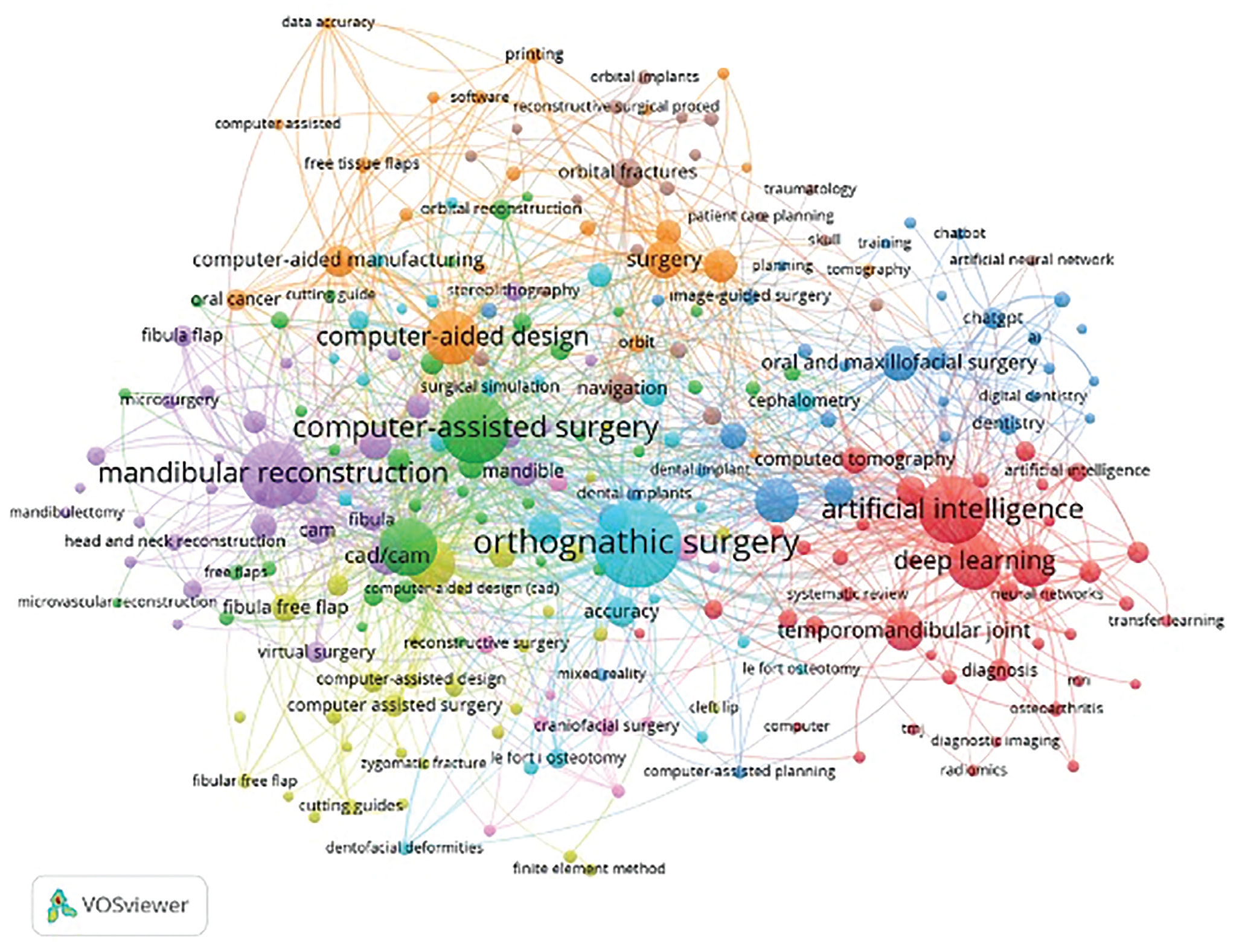
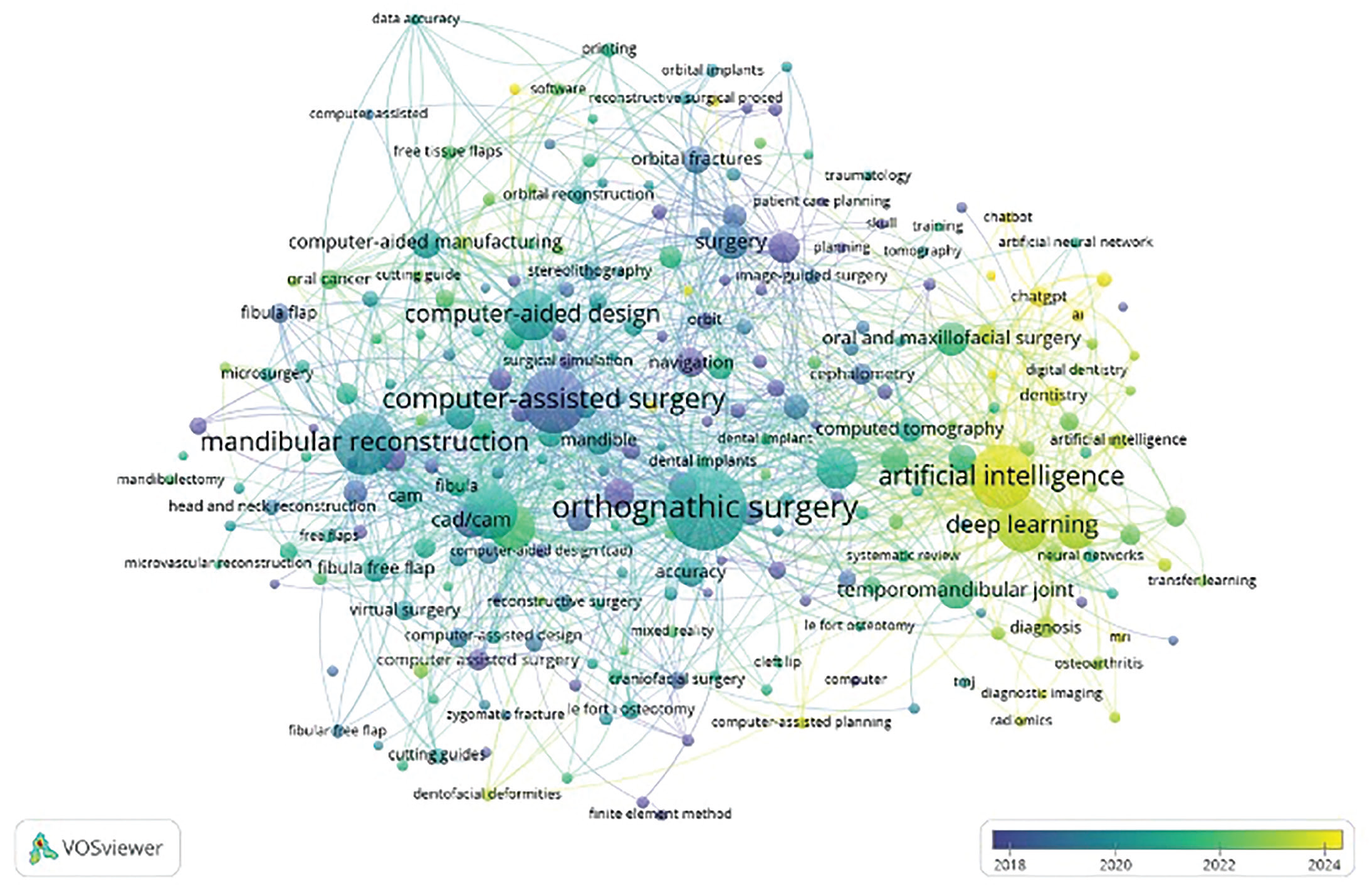
Author keywords and Keywords Plus were combined for co-occurrence analysis. presents the 20 most frequent keywords in the dataset. Orthognathic surgery, computer-assisted surgery, AI and mandibular reconstruction were among the most common terms, together with virtual surgical planning and CAD/CAM. Imaging-related keywords such as CBCT appeared predominantly in the context of surgical planning, navigation, and outcome assessment in OMFS, rather than as stand-alone radiological applications. “Accuracy” was among the most frequently occurring keywords, particularly with respect to surgical outcome prediction and anatomical segmentation tasks in OMFS. The keyword co-occurrence network is presented in , demonstrating several well-defined thematic clusters centred on AI applications in OMFS, including surgical planning, deep learning-based segmentation, and computer-assisted surgical workflows. The overlay visualisation shown in illustrates the temporal evolution of research topics, indicating a shift from early computer-assisted surgical approaches toward a more recent emphasis on deep learning, virtual surgical planning, and data-driven decision-support systems in OMFS.
Table 3. Most frequent keywords related to artificial intelligence applications in oral and maxillofacial surgery
Rank | Keyword | Occurrences |
|---|---|---|
1 | Orthognathic surgery | 318 |
2 | Computer-assisted surgery | 244 |
3 | Computer-aided design/CAD/CAM | 224 |
4 | Artificial intelligence | 186 |
5 | Mandibular reconstruction | 179 |
6 | Virtual surgical planning | 172 |
7 | 3D printing | 126 |
8 | Deep learning | 124 |
9 | Maxillofacial surgery | 81 |
10 | Surgical navigation | 77 |
11 | Machine learning | 76 |
12 | Temporomandibular joint | 65 |
13 | Accuracy | 41 |
14 | Cone-beam computed tomography | 37 |
15 | Mandible | 36 |
16 | Orbital fractures | 36 |
17 | Patient-specific implants | 29 |
18 | Facial asymmetry | 29 |
19 | Cephalometry | 22 |
20 | ChatGPT | 20 |
CAD/CAM: Computer-aided design/computer-aided manufacturing
Geographical Distribution of Publications
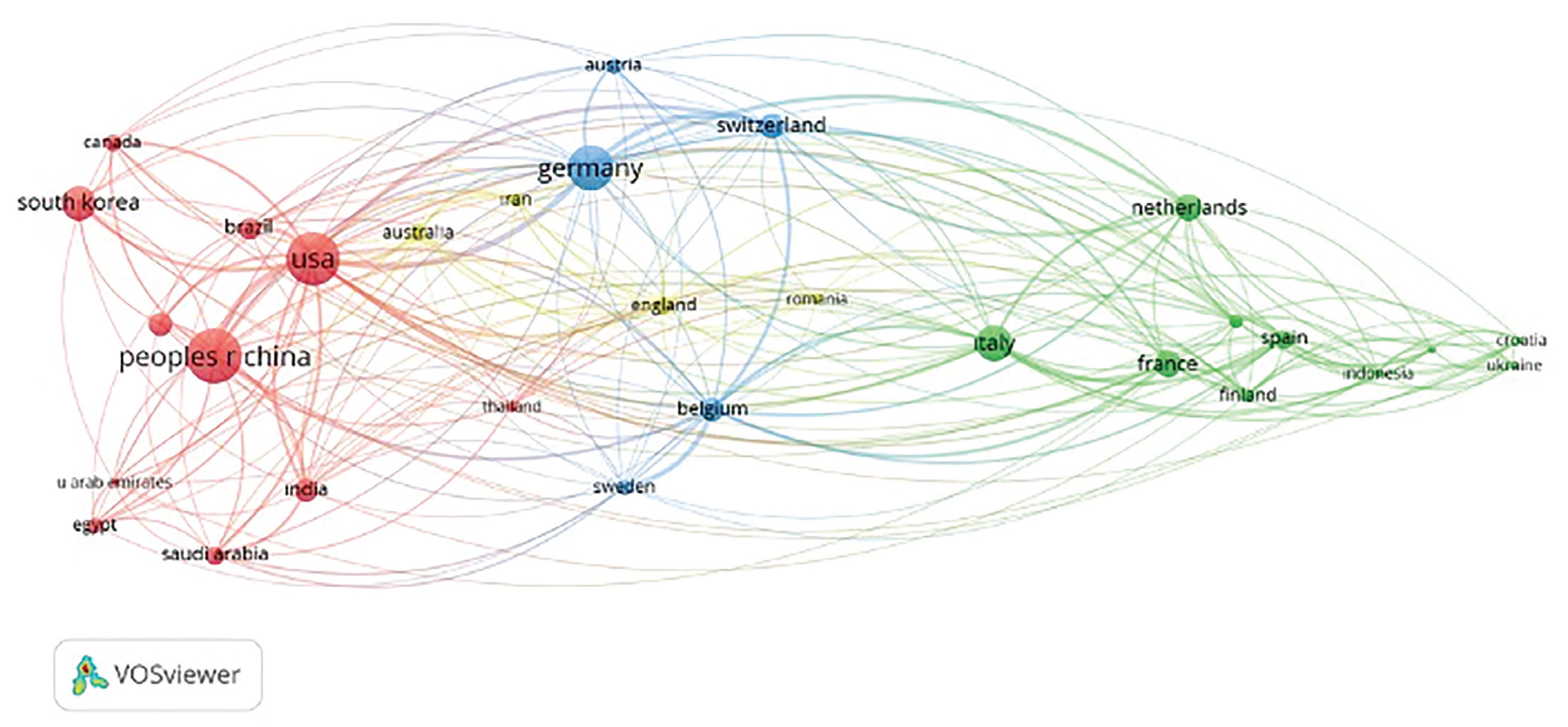
The geographical distribution of publications revealed that research on AI in OMFS was dominated by a limited number of countries (). The People’s Republic of China and the United States were the most productive countries, followed by Germany, Italy, and South Korea. Other major contributors included Japan, France, and the Netherlands, indicating strong research activity across East Asia and Western Europe. The country collaboration network is visualised in , revealing dense collaborative clusters among high-output countries and indicating that international co-authorship plays a substantial role in advancing research on AI in OMFS.
Table 4. The 10 most productive countries in AI-related OMFS publications (2000-2025).
Country | Number of publications | Percentage (%) |
|---|---|---|
People’s Republic of China | 355 | 18.16 |
USA | 344 | 17.60 |
Germany | 252 | 12.89 |
Italy | 157 | 8.03 |
South Korea | 144 | 7.37 |
Japan | 98 | 5.01 |
France | 92 | 4.71 |
Switzerland | 85 | 4.35 |
Netherlands | 82 | 4.19 |
Belgium | 70 | 3.58 |
AI: Artificial intelligence, OMFS: Oral and maxillofacial surgery
Institutional Productivity
Institutional analysis demonstrated that a small number of academic and clinical centres accounted for a substantial proportion of the published literature (). Shanghai Jiao Tong University and Peking University emerged as the most productive institutions, followed by several major universities and university hospitals from East Asia, Europe, and North America. This distribution reflects the concentration of AI-related OMFS research within high-volume tertiary care and research-orientated institutions.
Table 5. Leading Institutions in AI-related OMFS Publications (2000-2025)
Rank | Institution | Publications | % of Total records |
|---|---|---|---|
1 | Shanghai Jiao Tong University | 87 | 4.450% |
2 | Peking University | 59 | 3.018% |
3 | Sichuan University | 50 | 2.558% |
4 | Chang Gung Memorial Hospital | 49 | 2.506% |
5 | Chang Gung University | 44 | 2.251% |
6 | KU Leuven | 40 | 2.046% |
7 | Seoul National University | 38 | 1.944% |
8 | University of Hong Kong | 37 | 1.893% |
9 | Harvard University | 35 | 1.790% |
10 | University Hospital Leuven | 35 | 1.790% |
AI: Artificial intelligence, OMFS: Oral and maxillofacial surgery
Author Productivity
Analysis of author productivity showed that a limited group of researchers contributed disproportionately to the literature (). Gellrich NC, Lo LJ, and Marchetti C were among the most productive authors, each contributing more than 20 publications. The remaining highly productive authors demonstrated comparable publication outputs, suggesting the presence of several active research groups rather than a single dominant author.
Table 6. Most productive authors in AI-related OMFS publications (2000-2025)
Rank | Author | Publications | % of Total records |
|---|---|---|---|
1 | Gellrich NC | 25 | 1.279% |
2 | Lo LJ | 24 | 1.228% |
3 | Marchetti C | 24 | 1.228% |
4 | Hölzle F | 23 | 1.176% |
5 | Luo E | 23 | 1.176% |
6 | Politis C | 23 | 1.176% |
7 | Modabber A | 22 | 1.125% |
8 | Schramm A | 21 | 1.074% |
9 | Sun Y | 21 | 1.074% |
10 | Lin HH | 20 | 1.023% |
AI: Artificial intelligence, OMFS: Oral and maxillofacial surgery
Discussion
This bibliometric and science-mapping analysis demonstrates a steep and accelerating increase in AI-related publications in OMFS over the last 25 years. The surge in output after 2015 parallels the broader diffusion of deep learning frameworks and accessible GPU computing in medicine (, , ). Recent narrative reviews similarly emphasise that AI has transitioned from experimental proof-of-concept work to an integral component of digital OMFS workflows (-).
Geographical Distribution and International Collaboration
Analysis of publication output demonstrated that research activity related to AI in OMFS is concentrated in a limited number of countries. China emerged as the most prolific contributor, followed by several European countries, including Germany and Italy. Similar geographical patterns have been described in previous reviews of AI applications in dentistry and surgical disciplines, where research productivity has been linked to early technological adoption, availability of large digital datasets, and targeted national research funding strategies (, , ). The country collaboration network further revealed dense collaborative clusters among high-output countries, suggesting that international co-authorship plays an important role in advancing AI-related OMFS research.
Institutional Productivity and Research Concentration
At the institutional level, AI-related OMFS research was primarily conducted within large academic centres and university-affiliated hospitals. This finding is consistent with observations in the broader healthcare AI literature, where access to advanced computational infrastructure, annotated datasets, and interdisciplinary expertise is often required to develop and validate AI-based systems (). Systematic reviews focusing on OMFS have similarly noted that methodological innovation and clinical translation are frequently driven by specialised tertiary centres, which may limit the immediate applicability of AI tools in smaller clinical settings ().
Author Productivity and Collaborative Research Groups
Author productivity analysis indicated that a relatively small group of researchers contributed a substantial proportion of publications in this field. Such authorship patterns are common in emerging research areas and typically reflect the presence of established research groups that function as focal points for innovation and collaboration (). Following manual author name disambiguation, no single author was found to dominate the literature overwhelmingly, suggesting that research on AI in OMFS is distributed across multiple active groups rather than centred around a single leading contributor. This distribution may facilitate methodological diversity and promote balanced scientific development within the field.
Thematic Evolution and Emerging Research Trends
Keyword co-occurrence and overlay analyses demonstrated a clear temporal shift in research focus over the study period. Early publications predominantly addressed computer-assisted surgery and basic image-processing techniques, whereas more recent studies increasingly emphasise deep learning, virtual surgical planning, and data-driven decision-support systems. Although not all 3D printing technologies are inherently AI-driven, their frequent integration within AI-supported digital surgical workflows justifies their inclusion in the present analysis. Comparable thematic transitions have been reported in reviews examining AI applications in implant dentistry and related digital workflows (). Although several studies employed imaging-based data, these approaches were primarily integrated into surgical workflows rather than used as stand-alone radiological analyses, reinforcing the operative orientation of AI research in OMFS. The appearance of generative AI-related keywords, such as ChatGPT, reflects emerging interest in large language models (LLMs) for education, documentation, and decision-support tasks within OMFS. From a bibliometric perspective, the relatively low frequency of generative AI-related keywords compared with established surgical AI themes suggests that LLM-based applications remain an emerging and underrepresented research area within the OMFS literature. While AI has been extensively discussed in dentistry and broader clinical research with respect to its opportunities, limitations, and ethical challenges, the reflection of LLM-focused applications in OMFS publications remains limited. This discrepancy highlights a thematic gap between rapidly evolving AI methodologies and their current representation in OMFS-focused scientific literature, suggesting a potential direction for future research (). From the perspective of AI research, current bibliometric analysis highlights several key trends and shortcomings. While deep learning-based approaches dominate recent literature, methodological heterogeneity, limited external validation, and reliance on retrospective single-center datasets remain prevalent. Mapping these patterns is essential to guide future AI model development efforts toward standardized evaluation frameworks, transparent reporting, and clinically robust validation strategies. Furthermore, the concentration of research activity in a limited number of institutions underscores the need for broader interdisciplinary and multicenter collaboration to improve the generalizability of AI-based systems in OMFS (, ).
Clinical Implications and Future Directions
From a clinical perspective, the observed trends suggest that AI is becoming increasingly embedded in routine OMFS workflows, particularly in orthognathic surgery, mandibular reconstruction, trauma management, and computer-assisted surgical planning. Despite this progress, existing literature remains dominated by retrospective designs and single-centre datasets, which may constrain external validity and real-world implementation (). Future research efforts should therefore prioritise multicentre collaboration, standardised evaluation protocols, and prospective validation studies to support the safe and effective integration of AI technologies into everyday OMFS practice. From a clinical medicine perspective, the rapid growth of AI-supported OMFS research underscores the increasing integration of digital technologies into surgical decision-making, planning accuracy, and intraoperative guidance. Understanding these trends is essential for clinicians to critically evaluate emerging AI tools and support evidence-based adoption in daily practice.
AI applications supporting imaging-based components of OMFS workflows are dominated by deep learning-based segmentation and classification tasks. Layered convolutional networks have achieved expert-level performance for 3D segmentation of the mandible and other craniofacial structures on CBCT (, ), and several comparative studies report clinically acceptable accuracy for mandibular canal or defect segmentation, with substantial reductions in manual workload (, , , ).
Taken together, the existing literature suggests that AI has substantial potential to enhance diagnosis, planning precision, and intraoperative guidance in OMFS, but translation into routine clinical practice will depend on rigorous validation, standardisation of workflows, and careful consideration of ethical issues such as data privacy and algorithmic bias (1-4,15,21).
Study Limitations
A limitation of this study is that the bibliometric analysis was based solely on the WoS Core Collection, which may not capture all relevant publications indexed in other databases such as Scopus or PubMed. However, WoS was chosen for its standardized indexing criteria and widespread use in citation-based and science-mapping analyses.
Conclusion
Over the last 25 years, research at the interface of AI and OMFS has expanded rapidly, shifting from early work on stereolithography and navigation to deep learning-based image analysis and fully digital surgical workflows. The present bibliometric analysis shows that orthognathic surgery, mandibular reconstruction, virtual surgical planning, and computer-assisted surgery constitute the main thematic hubs, with deep learning and 3D printing emerging as key enabling technologies.
Although the existing literature demonstrates that AI has considerable potential to enhance diagnostic accuracy, planning precision, and workflow efficiency in OMFS, the evidence base remains dominated by retrospective, single-centre studies. To translate AI tools into routine clinical practice, future research should focus on multicentre prospective validation, rigorous reporting standards, and careful evaluation of clinical and patient-reported outcomes. The science-mapping results presented here can help researchers and clinicians identify influential contributions, recognise gaps in current knowledge, and prioritise high-impact avenues for future investigation.
Notably, the limited representation of ethics-related keywords in the bibliometric findings stands in contrast to the growing ethical complexity of AI applications in OMFS, including data confidentiality, algorithmic bias, and clinical accountability. This mismatch highlights a critical research gap and underscores the need for more explicit and systematic ethical discourse in future OMFS-focused AI research.
Footnotes
Ethics
Ethics Committee Approval: This study followed a bibliometric and science-mapping design and was conducted in accordance with reporting recommendations for bibliometric analyses.
Informed Consent: Only published literature was analysed and no individual patient data were used, ethical approval was not required.
Authorship Contributions
Concept: CG.T., M.K.H., M.Ü., N.A.G., O.Y., Ö.O.G., Design: CG.T., M.K.H., Data Collection or Processing: CG.T., M.K.H., N.A.G., O.Y., Ö.O.G., Analysis or Interpretation: CG.T., M.Ü., N.A.G., O.Y., Ö.O.G., Literature Search: CG.T., M.K.H., N.A.G., O.Y., Ö.O.G., Writing: CG.T., M.K.H., M.Ü.
Conflict of Interest: No conflict of interest was declared by the authors.
Financial Disclosure: The authors declared that this study received no financial support.
References
Dang RR, Kadaikal B, Abbadi SE, Brar BR, Sethi A, Chigurupati R. The current landscape of artificial intelligence in oral and maxillofacial surgery- a narrative review. Oral Maxillofac Surg. 2025;29:37.
Rasteau S, Ernenwein D, Savoldelli C, Bouletreau P. Artificial intelligence for oral and maxillo-facial surgery: a narrative review. J Stomatol Oral Maxillofac Surg. 2022;123:276-82.
Miragall MF, Knoedler S, Kauke-Navarro M, Saadoun R, Grabenhorst A, Grill FD, et al. Face the future-artificial ıntelligence in oral and maxillofacial surgery. J Clin Med. 2023;12:6843.
Abdali HM, Ayoub AY, Omer RA, Alanazi RA, Alsaedi BS, Almutairi LB, et al. Applications of artificial ıntelligence in oral and maxillofacial cosmetic surgery: a systematic review of diagnostic, planning, and outcome assessment tools. Cureus. 2025;17:e92185.
Kwon TG. Considerations for virtual surgical planning and simulation in orthognathic surgery. Front Oral Maxillofac Med. 2020;2:15.
Alkaabi S, Maningky M, Helder MN, Alsabri G. Virtual and traditional surgical planning in orthognathic surgery - systematic review and meta-analysis. Br J Oral Maxillofac Surg. 2022;60:1184-91.
Pampín Martínez MM, Gutiérrez Venturini A, Guiñales Díaz de Cevallos J, Barajas Blanco M, Aragón Niño I, Moreiras Sánchez A, et al. Evaluation of the predictability and accuracy of orthognathic surgery in the era of virtual surgical planning. Applied Sciences. 2022;12:4305.
Lee YJ, Oh JH, Kim SG. Virtual surgical plan with custom surgical guide for orthognathic surgery: systematic review and meta-analysis. Maxillofac Plast Reconstr Surg. 2024;46:39.
Shalabi MM, Darwich KMA, Kheshfeh MN, Hajeer MY. Accuracy of 3D Virtual surgical planning compared to the traditional two-dimensional method in orthognathic surgery: a literature review. Cureus. 2024;16:e73477.
Verhelst PJ, Smolders A, Beznik T, Meewis J, Vandemeulebroucke A, Shaheen E, et al. Layered deep learning for automatic mandibular segmentation in cone-beam computed tomography. J Dent. 2021;114:103786.
Ileşan RR, Beyer M, Kunz C, Thieringer FM. Comparison of artificial ıntelligence-based applications for mandible segmentation: from established platforms to ın-house-developed software. Bioengineering. 2023;10:604.
Issa J, Konwinska MD, Kazimierczak N, Olszewski R. Assessing the accuracy of artificial intelligence in mandibular canal segmentation compared to semi-automatic segmentation on cone-beam computed tomography images. Pol J Radiol. 2025;90:e172-9.
Abesi F, Jamali AS, Zamani M. Accuracy of artificial intelligence in the detection and segmentation of oral and maxillofacial structures using cone-beam computed tomography images: a systematic review and meta-analysis. Pol J Radiol. 2023;88:e256-63.
Fan W, Zhang J, Wang N, Li J, Hu L. The application of deep learning on CBCT in dentistry. Diagnostics. 2023;13:2056.
Ritto FG, Schmitt ARM, Pimentel T, Canellas JV, Medeiros PJ. Comparison of the accuracy of maxillary position between conventional model surgery and virtual surgical planning. Int J Oral Maxillofac Surg. 2018;47:160-6.
Schwendicke F, Samek W, Krois J. Artificial intelligence in dentistry: Chances and Challenges. J Dent Res. 2020;99:769-74.
Chen YW, Stanley K, Att W. Artificial intelligence in dentistry: current applications and future perspectives. Quintessence Int. 2020;51:248-57.
Esteva A, Robicquet A, Ramsundar B, Kuleshov V, DePristo M, Chou K, et al. A guide to deep learning in healthcare. Nat Med. 2019;25:24-9.
Mladenovic R, Pereira L, Pereira A. Artificial Intelligence in oral and maxillofacial surgery: a systematic review. Int. J. Oral Maxillofac. Surg. 2022;51:1-11.
Revilla-León M, Gómez-Polo M, Vyas S, Barmak BA, Galluci GO, Att W, et al. Artificial intelligence applications in implant dentistry: a systematic review. J Prosthet Dent. 2023;129:293-300.
Taghanaki SA, Abhishek K, Cohen JP, Cohen-Adad J, Hamarneh G. Deep semantic segmentation of natural and medical images: a review. Artif Intell Rev. 2021;54:137-78.
Kim SG. The new face of oral and maxillofacial surgery: artificial intelligence’s expanding role. J Korean Assoc Oral Maxillofac Surg. 2025;51:127-30.